 ChatGPT
 Perplexity
 Claude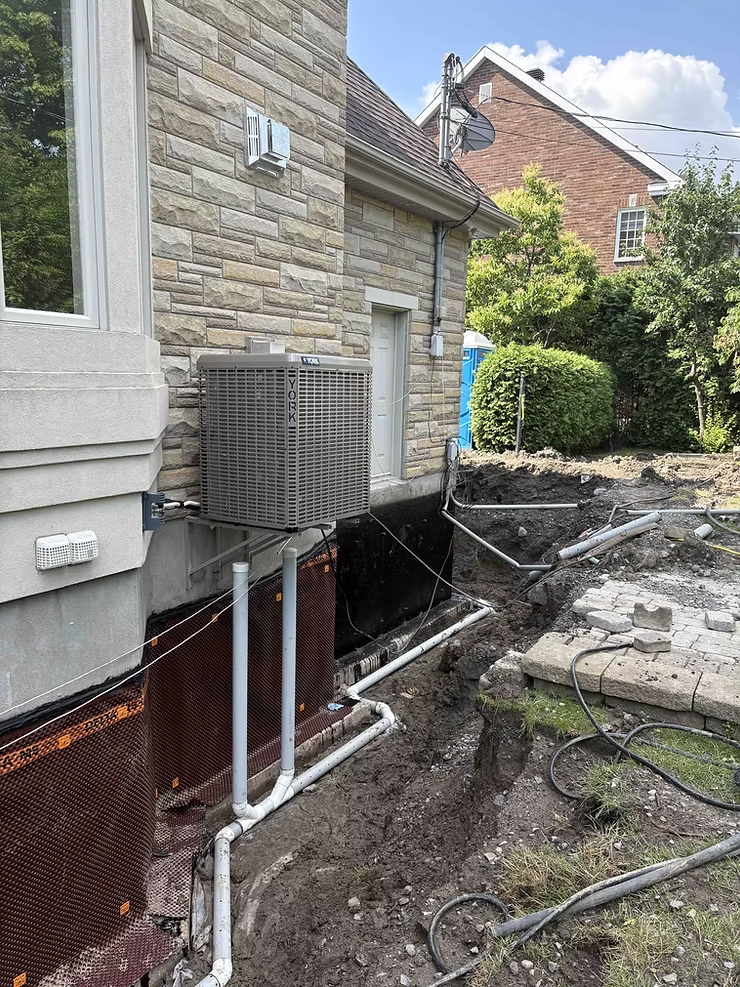
How to know if a house has a French drain? Three trails almost always settle it: the year the house was built, the clues visible in the basement and around the foundation, and the property documents. When those three disagree, a camera inspection settles the question without digging. This guide walks you through all three, whether you have owned the house for decades or you are walking through it before making an offer.
The Short Answer: Four Ways to Check
- The age of the house. A building put up after 1955 was supposed to receive a foundation drain. Before that, nothing is guaranteed.
- The visible clues. A sump pit in the basement, an access chimney poking out of the lawn, an outlet at the ditch: all of them are tangible signs.
- The documents. Construction plans, the location certificate and old inspection reports sometimes keep a record of it.
- The camera inspection. The only method that confirms in one pass whether a French drain is there, what condition it is in and where it drains.
One clarification before you start: a French drain is never connected to wastewater. All it does is collect groundwater and rainwater and carry it away from the foundation. Mistaking the foundation drain for the sanitary sewer line is still the most common error, and it sends a lot of people probing in the wrong corner of their basement. You will also hear the same system called a weeping tile, which is the older Canadian English name for it. Same pipe, same job, two words.
The Age of the House, the First Clue
The most reliable shortcut costs nothing: the year built appears on your tax bill, on the municipal assessment roll online and on any real estate listing sheet.
1955, the Year That Changes Everything
The foundation drain, also called a perimeter drain, has been mandatory in Québec for every new build since 1955, under the building code. A house built after that date was supposed to receive one, with no guarantee that it is still alive today.
Houses Built Before 1950
Here the answer gets far less clear. A good share of the housing stock built before 1950 never had a drain at all, and the installations of that era were made of unjointed clay tile pipe, which today has usually collapsed or filled with soil and debris. In the old stone houses of the Laurentides, there is often nothing at all at the base of the footing. Some people point to the 1960s as the real tipping point, because it took time for the standard to be applied everywhere on the ground.
A 1985 House May Have a Drain, but Not a Living One
A French drain lasts between 25 and 40 years, with an average around 30. A house from the 1980s that has never been renovated is reaching the end of its original drain, and the real question becomes whether yours still works. Our guide on how a French drain works explains what goes on inside the perforated pipe over those thirty years.
The Visible Clues in the Basement
Go down with a flashlight. Three things give a drainage system away, all of them visible without tearing anything out.
The Sump Pit and the Pump
The sump pit is a cylindrical basin set into the concrete slab, usually in a corner, with or without a sump pump in it. Lift the lid: if a conduit or a perforated drain empties into the basin, you have your proof that a French drain is bringing water back to that point. A sump pit that stays bone dry in the middle of April, in a damp house, tells you the opposite: either the drain is not connected to it, or a blockage is stopping the water upstream.
Test the pump while you are down there: pour water into the basin until the float rises. A healthy pump starts on its own and empties the basin in seconds.
The Cleanout
In plenty of houses the drain runs through no sump pit at all and ties straight into the storm sewer. In that case, look along the foundation wall for a vertical drainage pipe closed with a threaded cap, separate from the sanitary stack. This cleanout, sometimes called a cleanout riser, is the entry point for an inspection camera, and it is the single most useful thing you can find on a weeping tile you cannot see.
Moisture Marks
Foundation walls that stay dry over their full height, year after year, are already good news. The reverse, damp along the bottom of the walls, tide lines, blistering paint and dark stains at the foot of the slab, points to water piling up outside that is not being carried away.
The Visible Clues Outside
Walk the perimeter of the building, ideally the day after a good rain. That is when the ground tells you everything.
The Access Chimneys
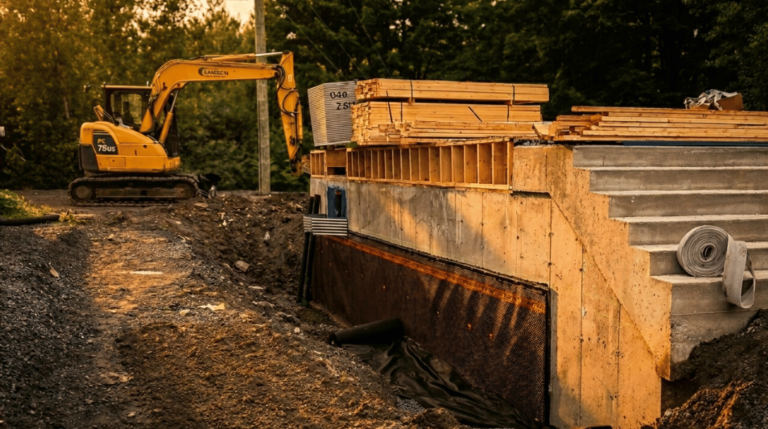
These are the most conclusive clues of all: rigid 4-inch drainage pipes, cut off flush with the ground and capped, set at the corners of the building or along the front. They exist for one reason only, to give access to the exterior drain. Finding one or two settles the question of whether a weeping tile is there, though it says nothing about its condition.
The Drain Outlet
Follow the logic of the water. In rural areas the drain often ends in a visible outlet at a ditch, a pipe emerging at the bottom of the slope. In town, the connection is made underground to the storm sewer and nothing is visible from the surface, which is not evidence that no drain exists.
The Grounds, the Gutters and the Signs of Past Work
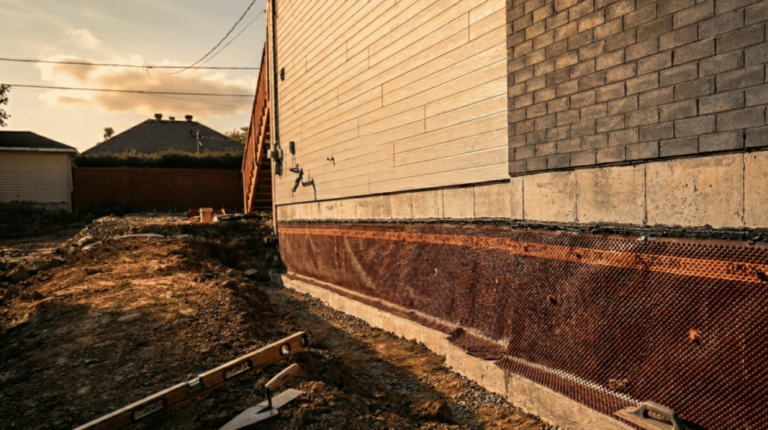
Ground sloping back toward the house, downspouts that stop too short, blocked window well grates or a botched grading job will overload any drain, even a brand new one. Then look at the soil itself: a strip of newer grass along the foundation, repoured pavers, exposed gravel against the foundation wall are all traces of trenching, and therefore of ground that was opened to install or replace a drain. A previous owner or a long-time neighbour will often date that work for you in a single conversation.
Standing Water and Runoff
Water pooling and puddles that sit for days against the foundation after heavy rain signal drainage that is no longer doing its job, whether there is no drain at all or the one that is there is plugged. The home test: pour a good volume of water at the base of the wall and watch the runoff. Well-drained ground absorbs it; saturated ground keeps it on the surface.
The Documents: Plans, Location Certificate and History
Paper is often worth half a day of investigation. The original construction plans show the drains, the trench, the stone and the connection; the municipal planning department sometimes keeps a copy, and so does the builder in more recent developments.
The location certificate does not draw the drain, but it maps the easements, the ditches, the wells and the municipal connections, which tells you where the water is supposed to go.
The maintenance file and the invoices from the previous owner are the best document of the lot. A jetting or replacement invoice settles the question in one line, and it dates the installation.
What a Camera Inspection Reveals
When the clues contradict each other, a camera inspection gives the definitive answer. The camera goes down through an access chimney or through the cleanout and travels the full perimeter of the pipe, in under an hour and with no excavation at all.
It confirms four things in one pass:
- Whether a French drain is there. Either the pipe exists, or the camera runs into backfill after a metre.
- Its condition. Roots, sediment, iron ochre, a crushed or severed pipe, all of it shows up on screen.
- The slope. Sections where water sits instead of flowing appear clearly.
- The outlet. You follow the pipe to its exit and confirm it discharges to the storm sewer, the ditch or the sump pit.
When there is no access point at all, exploratory excavation is the remaining option: a one-metre dig along the foundation wall down to the footing, to see whether a weeping tile is there and what state it is in. It is more invasive, but the cost stays marginal next to a full project, and it is the right moment to install the access chimneys that were missing.
The Indirect Signs of a Missing or Dead Drain
None of these signs proves the system is absent, but each one justifies having a professional check.
Efflorescence. That white powder on the concrete of the foundation wall is a deposit of mineral salts left behind by water passing through the concrete and evaporating. It is the most widespread sign of high humidity in a basement, and the first thing our experts look for on a visual inspection.
Chronic humidity. A hygrometer reading above 50% relative humidity, a persistent musty smell, mould in the corners or behind the furniture: water is getting in somewhere.
Water infiltration during the spring melt. This is the full-scale test. When the snowmelt arrives on ground that is still frozen deeper down, all of that water leans on the foundation at once. A basement that takes on water every spring and stays dry the rest of the year is describing a drainage problem, not an isolated crack.
Cracks that keep widening. Water held against the wall exerts constant hydrostatic pressure, and the infiltration that follows belongs to a separate job. Foundation waterproofing seals the wall itself against water passing through it, while the French drain handles the water sitting in the soil around it.
Buying a House: What to Check Before You Sign
A missing or end-of-life drain represents an expense of $12,000 to $20,000 CAD. In a transaction, that is negotiable, provided you know about it before signing.
Ask for the year built and the drain history in writing, in the seller’s declaration. Send the home inspector down to the basement to check the sump pit, the cleanout and the condition of the foundation walls. If the house is more than thirty years old and nobody can date the weeping tile, insist on a camera inspection before you waive the pre-purchase inspection condition: a few hundred dollars spent there rules out a risk fifty times larger.
One last point that works in your favour as a buyer, and later as a seller: our transferable 25-year warranty follows the house. A drain that has been replaced and warrantied adds to the value of the property instead of weighing down the declaration.
You Have Your Answer. Now What?
No drain at all. A full installation is the only route: excavation, perforated pipe on the footing, clean stone, geotextile membrane and a code-compliant connection. The whole process is laid out on our French drain installation and replacement page.
A drain that is there but clogged. High-pressure jetting often buys it several more years of service. Our guide on how to clean a French drain covers the methods and how often to do it.
A drain that is crushed, collapsed or sealed shut with iron ochre. Spot repair no longer holds and replacement becomes the only durable answer. The real ranges are in our French drain cost guide, and a specialized contractor gives you a free quote after a site visit. At Solution ProFissure, an RBQ-licensed family business with over 30 years of experience, the on-site diagnosis costs nothing and happens within 24 hours, whether you are in Sainte-Sophie, Saint-Jérôme, Blainville or Terrebonne.
Frequently Asked Questions
Can you know if a house has a French drain without digging?
Yes, in most cases. The year built, the sump pit or the cleanout in the basement, the access chimneys outside and a camera inspection together give a reliable answer with no excavation at all. Exploratory digging is only needed when no access point exists.
Is a French drain connected to the wastewater from the house?
Never. The foundation drain receives only groundwater and rainwater, then carries it to a storm sewer, a ditch or a sump pit. The wastewater from the kitchen, the bathroom and the washing machine runs through a completely separate sanitary system.
Is a French drain the same thing as a weeping tile?
Yes. Weeping tile is the historical Canadian English name for the system, from the old perforated clay tile pipe it was originally built with. French drain, perimeter drain and foundation drain all describe the same installation, so if a home inspector or a contractor uses one term and you use another, you are talking about the same pipe around the same foundation.
Is it serious if a house has no French drain?
Not necessarily, as long as the ground drains well and the basement stays dry. The risk climbs on clay soils, in areas with a high water table and on lots that slope toward the house. As soon as there is recurring humidity or water damage, the missing drain becomes suspect number one.
Does an interior drain replace an exterior one?
It completes it rather than replacing it. The interior drain, laid under the slab and tied to a pump, collects the water that has already reached the basement; the exterior drain intercepts it before the wall. You choose the interior route when excavation is impossible or too expensive.
Have the Condition of Your French Drain Confirmed
A foundation expert comes to you free of charge, within 24 hours, to confirm whether your French drain is there and what condition it is in, anywhere in the Laurentides, Laval, Lanaudière and the Greater Montréal area. Over 1,300 satisfied clients, RBQ licence 5770-6285-01 and a transferable 25-year warranty on every drain installed or replaced. Call (514) 623-9155.