 ChatGPT
 Perplexity
 Claude
In Quebec, a French drain is mandatory for every new build, but a house without a French drain that already stands remains perfectly legal: the requirement governs the act of building, not the ownership of an existing building.
So why are so many owners of homes from the 1940s or 1950s told they are not up to code?
In this guide, you will learn:
- What the Quebec Construction Code requires, and for which type of building
- Why an older house with no foundation drainage is still compliant
- What actually happens to a basement with no French drain
- Your real options: exterior drain, interior drain or surface fixes
French drain rules for new construction
Yes, a French drain is mandatory in Quebec, with one detail that changes everything: it is mandatory for building. The Quebec Construction Code, which adopts the National Building Code of Canada, requires drainage at the bottom of the exterior foundation walls of every new building. The requirement is long-standing and the standards have tightened over time. The contractor holding a licence from the Régie du bâtiment du Québec (RBQ) answers for it, not the homeowner who buys the house twenty years later. For the mechanism itself, see our guide on how a French drain works.
Pipe diameter, stone and drain depth
Section 9.14 of the Quebec Construction Code, as detailed by Garantie de construction résidentielle (in French) requires a drainage pipe around the foundation footings, with a minimum diameter of 100 mm (4 in.), covered by at least 150 mm (6 in.) of clean crushed stone. The APCHQ sets out the same standards and adds that the collected water must discharge to a sewer, a ditch or a dry well. In Quebec, the drain is laid below the frost line, 4 to 5 feet deep depending on the region, so it keeps draining during the thaw. The geotextile goes over the stone rather than directly on the perforated pipe, to filter fine particles out of the backfill without clogging the perforations.
The exception built into the Code
The Code leaves one way out: drainage may be omitted if a professional's written opinion, backed by a geotechnical report, shows that the site makes it unnecessary. Highly permeable soil, a deep water table or a building with no basement can justify this exemption. In the clay soils of the Laurentians, Laval and Lanaudière, that demonstration remains rare. And once a drainage system is installed, it must meet the Code's standards, exemption or not.
Is a house without a French drain illegal?
No. A house built in 1940 without a foundation drain complies with the rules in force when it was built, and nothing in the Code requires its owner to install one today. The Construction Code applies to work: new construction, additions, rebuilding. Living in a building that already stands falls outside that logic. This is the distinction most articles gloss over, and it changes everything for a homeowner who wonders whether they are breaking the rules.
The requirement targets construction, not ownership
When a contractor pours a new foundation in 2026, the municipality and the RBQ require the drainage set out in the Code. When you live in a house built in 1948, the same Code is silent on your case: it does not apply retroactively to buildings erected before it came into force.
A building permit triggers the standards. Living in an existing house is a matter of maintenance and of the owner's judgment.
The acquired rights of an older house
A building that was legal when it went up keeps its acquired rights, what many people call grandfathering. Your insurer, your municipality and a future buyer may all take an interest in the condition of your drainage, but having no French drain is not an offence in itself. The real question becomes technical rather than legal: will your basement stay dry next spring?
Major renovations and code compliance
The math changes as soon as you start work. An addition, the rebuilding of a foundation wall or perimeter excavation puts the project back under the Construction Code, and the drainage must then meet current standards. Check with your municipality before you dig: the permit and the Info-Excavation locate request are mandatory steps for any work along a foundation.
What happens without a French drain?
A property with no French drain can stay dry for decades when the lot is properly graded, the soil is permeable and the water table is low. On the clay soil of the Lower Laurentians, the story rarely ends there. Rain and snowmelt saturate the backfill, and water runs down the foundation wall and builds up against the concrete with no path to drain away.
One point some competitors muddle deserves to be cleared up: a French drain never carries wastewater. It handles only groundwater and stormwater, which is why it connects to a storm sewer, a ditch or a dry well.
Basement humidity and water infiltration
The first sign is rarely a puddle. It is a persistent musty smell, high humidity, white efflorescence on the concrete or mould at the bottom of the partition walls. Then comes outright water infiltration, often at the joint between the footing and the wall, during the spring thaw. A finished basement makes the bill worse: the flooring, partitions and insulation soak up water long before you see it.
Hydrostatic pressure on the foundation
Water held in the backfill puts constant hydrostatic pressure on the foundation walls. The higher the water column, the stronger the push: a basement whose backfill is saturated up to grade level carries a considerable load on every wall. The drain neutralizes this mechanism by lowering the water level down to the footing, where the perforated pipe collects it and carries it away by gravity.
Foundation cracks and movement
Pressure and freeze-thaw cycles eventually open up the concrete. Horizontal cracks and stair-step cracks in block walls are the classic signatures of a drainage problem, rather than normal concrete shrinkage. Left uncorrected, these openings progress to structural damage. A missing drain and a foundation crack belong to the same file: repairing the concrete without fixing the cause is like mopping under an open tap.
How can you tell if a French drain exists?
Three simple clues: the age of the building, an access cleanout or inspection port around the outside perimeter, and a sump pit with a sump pump in the basement. The certificate of location and the construction plans, when they exist, often settle the question, and documents drafted in English sometimes use the foundation drain's historical name, weeping tile. We explain the full method in our article on how to know if a house has a French drain.
When doubt remains, a French drain camera inspection gives you the answer in a single visit: the camera goes in through the access cleanout, films the inside of the pipe and shows whether it is intact, collapsed, blocked by roots or clogged with iron ochre. It is also the only way to tell a missing drain from a failed one, two situations that produce exactly the same symptoms in the basement.
Adding a French drain to an existing house
Nothing forces you to, but a basement that gets damp every spring ends up costing more than the drain itself. Three routes exist, from heavy excavation to surface fixes. The same project also serves to replace a perimeter drain that is already in place but no longer working.
The exterior drain through excavation
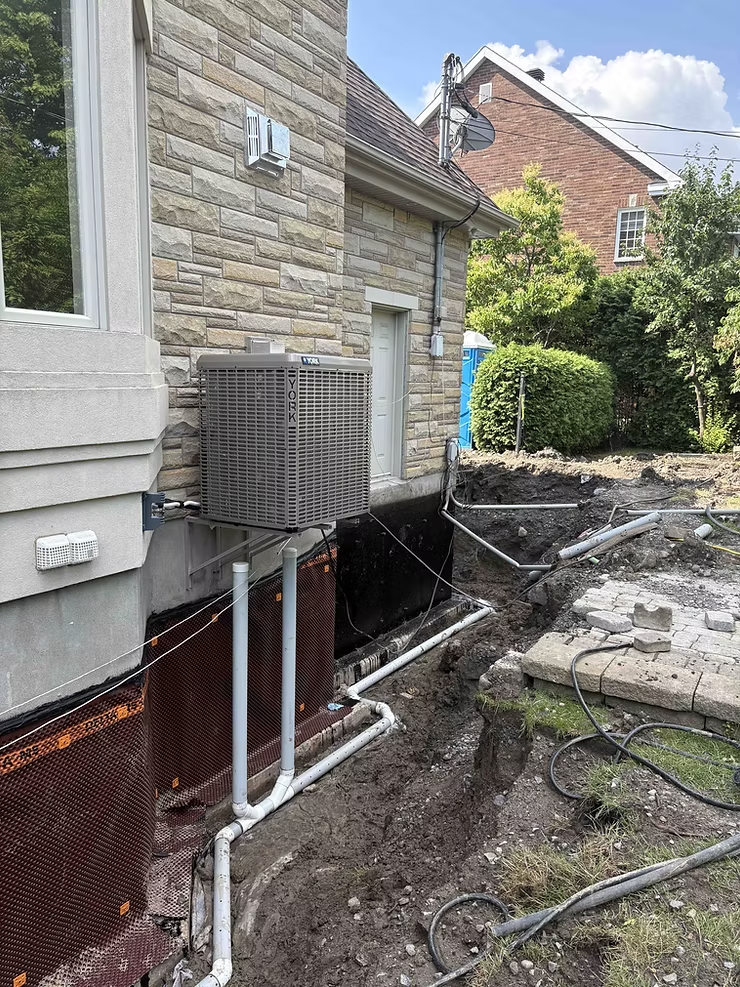
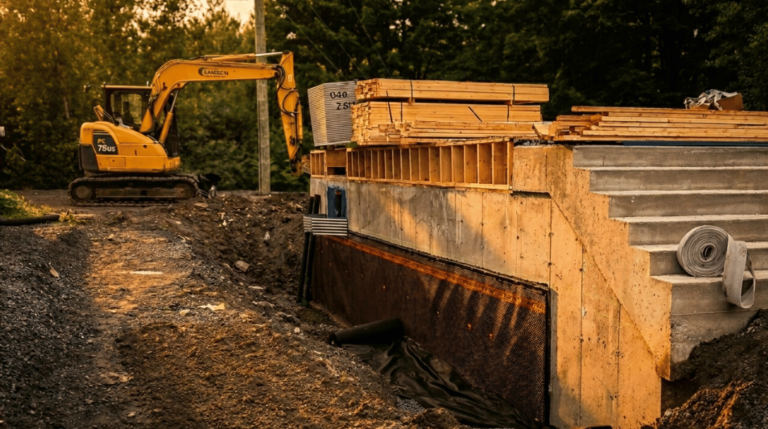
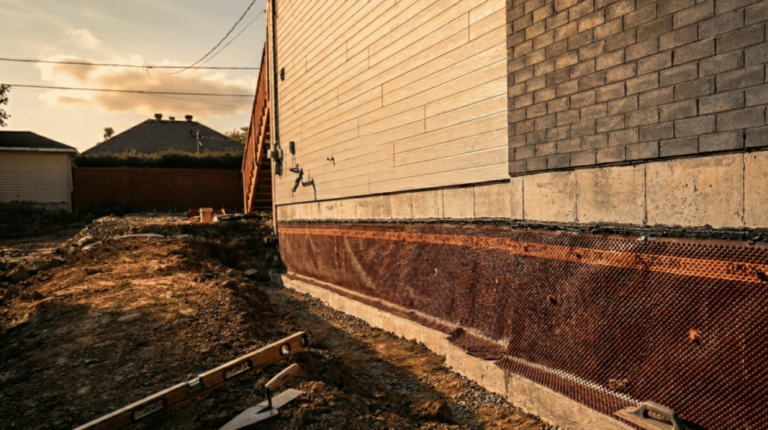
This is the benchmark solution. Excavation exposes the foundation down to the footing, and the 100 mm perforated pipe is laid at the bottom of the trench, on undisturbed soil, with a slope of about 1%, surrounded by clean stone and covered with geotextile. The project is also the time to apply waterproofing (tar, liquid rubberized membrane or Delta-MS membrane) before backfilling. The work takes three to five days for a single-family house and disrupts the landscaping. Price ranges, calculated per linear foot of perimeter, are detailed in our guide to French drain cost.
The interior drain under the slab
When excavation is impossible because of an attached garage, a neighbour too close or a steeply sloped lot, the basement concrete slab is opened along the interior perimeter and a drain is installed, connected to a sump pit and a sump pump. The basement stays dry, but water keeps pressing against the foundation wall: this option manages the symptom inside rather than the pressure outside. It serves mainly as a complement when an existing exterior drain has failed.
Gutters, window wells and lot grading
Before you dig, eliminate the avoidable sources of water. Downspouts that discharge water well away from the foundation, sealed window wells around basement windows and grading that slopes away from the house over the first few feet reduce the water load around the perimeter. These fixes cost a few hundred dollars and are sometimes enough to dry out a slightly damp basement. They also extend the lifespan of an existing drain, as does cleaning a French drain by hydro-jetting.
French drains and buying or selling a house
A missing French drain almost always comes up during the pre-purchase inspection. The building inspector notes the age of the house, looks for the access cleanout, measures moisture in the basement walls and records the limits of the mandate: the inspector observes without digging. The result then weighs on price negotiation far more than on the legality of the sale.
On the seller's side, everything you know about the condition of the drainage and past water infiltration belongs in the declarations you sign, and questions about latent defects are for a notary or a lawyer rather than a contractor. At Solution ProFissure, a family business, RBQ certified for over 30 years, every French drain installation is covered by a transferable 25-year warranty that follows the house to the next owner. It is a concrete selling point when the time comes to sell: it protects the property's resale value.
Unsure about your French drain?
A free on-site assessment, within 24 hours, tells you whether your house has a foundation drain and what condition it is in.
Get my free assessmentFAQ: house without a French drain
Is a French drain mandatory in Quebec?
Yes, for all new construction. The Quebec Construction Code requires drainage at the bottom of the exterior foundation walls of every new building, with a pipe at least 100 mm in diameter and 150 mm of crushed stone. The requirement applies to whoever builds: it targets the construction project, not the owner of a house that already stands.
Is my 1950 house out of compliance?
No. A house built without a French drain at a time when nothing required one keeps its acquired rights and remains compliant. Your municipality will ask you to add a foundation drain only when work puts the building back under the Code: an addition, the rebuilding of a foundation wall or perimeter excavation.
Since what year has a French drain been mandatory?
The year 1955 circulates everywhere in Quebec, but no primary source confirms it: the Quebec Construction Code itself has been in force since 1976. What is certain and verifiable is the current requirement and its standards: a minimum diameter of 100 mm, 150 mm of crushed stone cover, installation below the frost line at 4 or 5 feet depending on the region, and discharge to a sewer, a ditch or a dry well.
How do I know if my house has a French drain?
Look for an access cleanout or inspection port around the outside perimeter and a sump pit with a sump pump in the basement, then check the construction plans or the certificate of location. The age of the building gives a first clue. A camera inspection remains the only method that confirms both that the drain exists and what condition it is really in.
Can you sell a house without a French drain?
Yes. Selling a house with no foundation drain is perfectly legal in Quebec. The pre-purchase inspection will note the lack of drainage and the buyer will use it in the negotiation, especially if the basement shows signs of moisture or mould. Questions about latent defects are for a notary or a lawyer rather than a contractor.
Does an interior drain replace an exterior drain?
It replaces it functionally when excavation is impossible, but the two systems work in different places. The exterior drain intercepts water before it reaches the foundation wall and relieves hydrostatic pressure. The interior drain collects under the slab what has already come through the concrete, then removes it with a sump pump.
Does a French drain carry wastewater?
No, never. This system handles only groundwater and stormwater around the foundation. It connects to a storm sewer, a ditch or a dry well, on a circuit kept separate from the house's wastewater. Confusing the two systems leads to connections that most Quebec municipalities prohibit.
Do you need a permit to add a French drain?
In most Quebec municipalities, yes: excavating along a foundation requires a permit, and a prior locate request with Info-Excavation is mandatory before digging. Your contractor, who holds an RBQ licence, files the application, coordinates the locate and gives you a detailed quote for the work.
Ready to install a French drain?
A detailed quote and a transferable 25-year warranty before any work begins: excavation, Code-compliant drain and waterproofing.
Request my free quote