 ChatGPT
 Perplexity
 Claude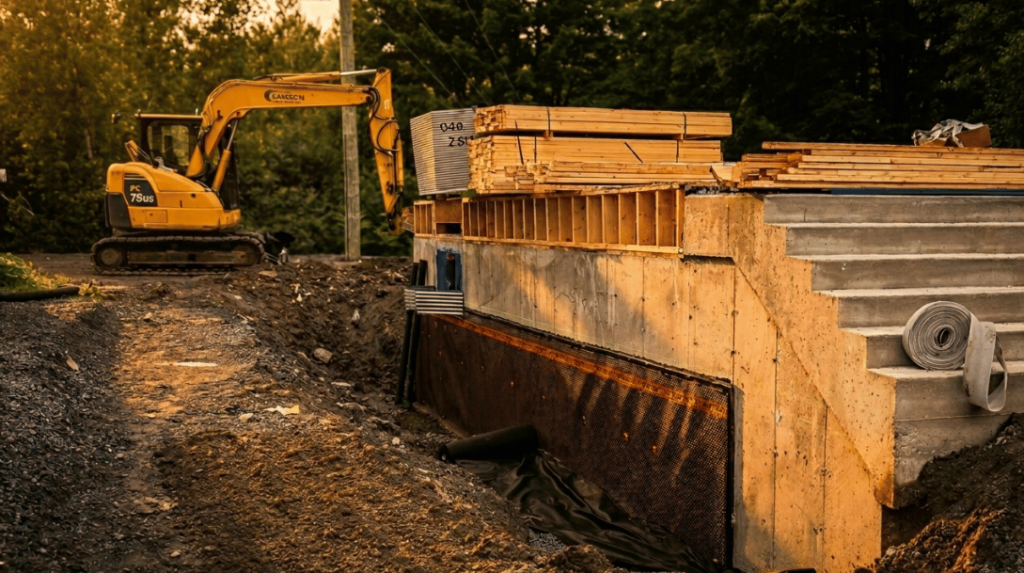
Foundation waterproofing means building a continuous waterproof barrier on the outside face of the foundation wall, so that water in the soil cannot make its way through the concrete. In Quebec, between snowmelt, clay soils and freeze-thaw cycles, that barrier works hard. This guide explains how exterior foundation waterproofing actually works: the real steps, the difference between waterproofing, a French drain and dampproofing, how to choose a membrane, the 2026 standards, and what changes on a fieldstone wall.
How does foundation waterproofing work?
Concrete is not a watertight material. Its porosity lets soil moisture migrate through by capillary action, and every cold joint, every shrinkage crack and every pour line offers water an even more direct route. As soon as the water table rises, water exerts hydrostatic pressure against the foundation wall and looks for the smallest weakness.
Waterproofing answers that problem in three moves. A waterproofing membrane seals the wall over its full buried height, from the top of the footing up to grade level. A drainage board carries water down along the wall, and the French drain collects it at the base of the foundation and takes it away. That trio is what keeps a basement dry, never the membrane on its own. This kind of foundation protection service is preventive: you install it before the water damage, not after.
Waterproofing, French drain or dampproofing: stop mixing them up
Three terms come up in quotes and they do not mean the same thing. Waterproofing and the French drain complete each other. A dampproofing treatment replaces neither one.
Waterproofing: the barrier on the wall
Waterproofing a foundation means making the wall itself impermeable. We excavate, clean the concrete, repair the cracks, then apply an elastomeric membrane or a dimpled membrane that blocks the passage of water. That barrier protects the structure, not the ground: on a lot with no drainage, water still builds up against the foundation.
The French drain: drainage at the footing
The French drain, called weeping tile elsewhere in Canada, is a perforated pipe laid on the foundation footing, surrounded by clear ¾ stone and wrapped in a filter geotextile. Its job is not to block water but to drain it toward a storm sewer, a ditch or a sump pit. It never carries wastewater: groundwater and rainwater only. Our guide breaks down how a French drain works step by step.
Dampproofing: a coating, not a waterproofing system
A dampproofing treatment is applied at the surface and reduces how much water the concrete absorbs, without creating a continuous barrier. It slows moisture down; it does not cancel hydrostatic pressure. Sold as basement waterproofing, it is an expensive shortcut: the water simply comes out somewhere else, as efflorescence, as mould or as paint that blisters.
The 6 steps of exterior foundation waterproofing
Here is how exterior foundation waterproofing unfolds on an existing house. The work runs three to six days, depending on access, depth and weather.
1. Excavation around the foundation and cleaning
The job opens with excavation around the foundation, down to the footing. Before the first bucket, we have Hydro-Québec and Énergir locate their services and we check whether the municipality requires a permit. Then comes cleaning the wall: soil, flaking old tar, laitance and roots. This surface preparation determines how well the membrane will bond.
2. Crack and joint repair
A wall that leaks cannot be waterproofed, so the cracks come first. Shrinkage cracks and cold joints are sealed, active cracks receive an expanding polyurethane injection, and the raked joints of a concrete block wall are repointed with hydraulic mortar. A structural crack calls for the opinion of a structural engineer. To settle the question, read how to tell whether a foundation crack is serious, or hand the diagnosis to our foundation crack repair service.
3. Tar and liquid rubberized membrane
The clean wall then receives its waterproofing coat. Tar, or bituminous coating, is still the classic method. On more demanding jobs we spray a liquid rubberized membrane instead, applied in several passes, which cures into a continuous seamless film that follows every irregularity in the poured concrete.
4. Installing the Delta-MS dimpled membrane
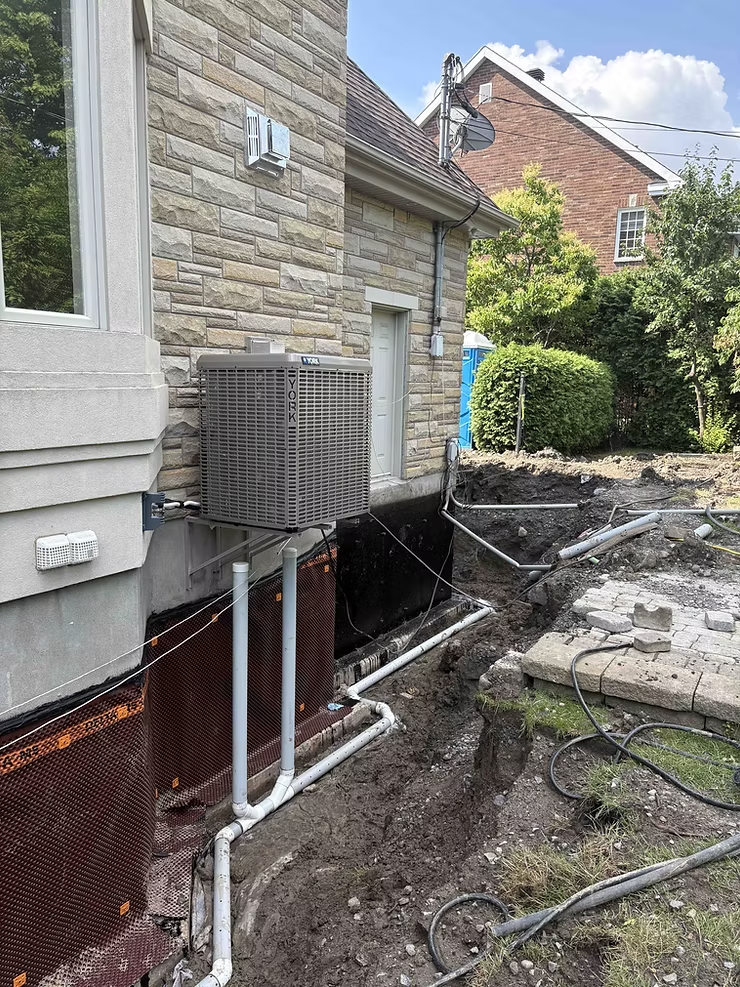
Over that goes the Delta-MS dimpled membrane. This dimpled drainage board creates an air gap between the soil and the wall: water runs down through the dimples to the drain instead of sitting against the concrete, and the liquid coat stays protected during backfilling.
5. Sump pit and sump pump
When the lot does not allow gravity drainage, water is routed to a sump pit where a submersible sump pump discharges it well away from the house. In a basement that has already taken on water, interior drainage under the slab completes the system.
6. Backfill in compacted lifts and finishing
Backfilling is done in compacted lifts, with a free-draining material rather than clay pushed back against the wall. We finish by grading the lot with a positive slope and checking how surface water is managed: downspouts have to discharge past the backfill.
Have the exterior waterproofing of your foundation assessed
A foundation expert comes to your home at no charge, within 24 hours, to inspect your wall and tell you exactly what it needs.
Explore our waterproofing service
Which membrane for which case: bituminous, dimpled, elastomeric
No family is better in absolute terms, whatever the manufacturers claim. The right choice depends on the wall, the soil and the budget.
The bituminous membrane
Tar applied hot or cold is the most common and the least expensive option. It bonds well to poured concrete and goes on fast. Its low elasticity does break down under freeze-thaw cycles, though: on a foundation that moves, a shrinkage crack eventually telegraphs through the bituminous coating.
The Delta-MS dimpled membrane
The dimpled membrane does not try to stick to the wall: it protects it mechanically and it drains. As a drainage board it is durable and unaffected by frost. But it is not a waterproofing membrane on its own: it delivers its full value over a bituminous coating or a liquid hydrophobic membrane.
The elastomeric or liquid rubberized membrane
Sprayed or trowelled on, the elastomeric membrane forms a continuous, seamless, highly adhesive film that moves with the concrete. Polyurea formulations push flexibility further and stay resistant at extreme temperatures. It is the most expensive family, and the most relevant one on walls that are already cracked.
Why the Quebec climate attacks foundation waterproofing
Foundation waterproofing in Quebec does not face the same stresses as elsewhere. Two mechanisms explain almost every failure.
Freeze-thaw and a frost line 4 to 5 feet down
The frost line sits between 4 and 5 feet deep depending on the region. In winter the soil freezes to that depth and expands; in a thaw it melts, then freezes again. Every freeze-thaw cycle pushes laterally on the foundation wall, reopens hairline cracks and lifts rigid coatings off the concrete. A rigid membrane takes those movements without absorbing them.
Clay soils, snowmelt and hydrostatic pressure
Much of the Laurentides, Laval and Lanaudière sits on clay soils that hold water instead of letting it drain away. In spring, snowmelt saturates the surface while the deeper soil is still frozen, and the water then leans on the foundation. Hydrostatic pressure climbs, and that is when most water infiltration shows up. Add iron ochre, which leaves a clogged drain in several sectors of Greater Montreal, and a damp basement becomes unavoidable. If the water is already showing, see how to repair a water infiltration in a basement wall.
The case of the fieldstone foundation
The older housing stock of the Laurentides includes many heritage homes built on a fieldstone foundation, an assembly of natural rubble stone bound with mortar. That wall was never designed to be watertight: it breathes and its mortar washes out. Waterproofing a fieldstone foundation therefore has nothing to do with waterproofing a poured concrete wall. You have to repoint with hydraulic mortar, stabilize the loose stones, then select a liquid elastomeric membrane able to follow an irregular surface, where a sheet membrane would never hold. Our foundation repair and replacement crews work on these houses often.
Standards, permits and compliance in Quebec
No standard imposes a brand of membrane, but foundation waterproofing sits inside a precise framework. The Quebec Construction Code (Code de construction du Québec), which incorporates the National Building Code, requires foundation walls in contact with the soil to be protected against moisture and the foundation drain to be connected. That drain has been mandatory in Quebec since 1955: minimum diameter of 100 mm (4 in.), at least 150 mm (6 in.) of filter gravel, installed below the frost line, discharging to a sewer, a ditch or a dry well. The APCHQ completes the framework with its best practice guides. For compliance, insist on a foundation contractor holding a valid RBQ licence. At Solution ProFissure, a family business RBQ certified for over 30 years, every job comes with a 25-year transferable warranty, an asset for the value of the property.
How much does foundation waterproofing cost?
The price of foundation waterproofing varies with access, depth and the condition of the wall, so these figures are indicative. In Quebec in 2026, exterior waterproofing combined with French drain replacement runs around $120 to $150 per linear foot, or $12,000 to $20,000 for a single-family home.
Frequently asked questions about foundation waterproofing
Can a foundation be waterproofed from the inside?
Interior waterproofing treats the symptoms: sealing cracks by injection, interior drainage under the slab, a submersible pump. It does not remove the hydrostatic pressure bearing on the wall. Exterior waterproofing remains the only method that stops water before it reaches the concrete. The two are combined when excavation is impossible.
How long does foundation waterproofing last?
Done properly, exterior waterproofing gives long-term protection of 25 to 40 years, the same service life as the French drain that goes with it. A bituminous coating on its own ages faster than an elastomeric membrane. A camera inspection of the drain every three to five years remains the best indicator of its condition.
Does a new build need waterproofing?
Yes. On a new build, the membrane goes on while the trench is still open, so at a fraction of the cost of redoing it on an existing house. It is the most cost-effective moment to seal the foundation wall and avoid concrete deterioration and structural damage.
Have your foundation waterproofed by an RBQ licensed specialist
More than 1,300 satisfied clients and 350+ projects completed in 2024: our specialists inspect your basement free of charge within 24 hours, and every job is covered by our 25-year transferable warranty. Call (514) 623-9155 for the peace of mind of a dry basement.